Quick Repair Solution for Burst or Leaking HDPE Pipe Welds: ATK Brass-Grip Repair Clamp
A burst HDPE pipe or a leaking weld joint mid-line is a situation every water utility eventually faces, and it always demands a fast response since it directly affects water supply continuity for customers. The traditional fix is to dig up the pipe, cut out the damaged section, re-weld it or replace the whole segment with new pipe – costly in time, and it forces a long water outage for the whole area.
The fastest repair solution for this situation is a brass-grip repair clamp: clamp it around the burst section or failed weld, tighten the bolts, done – no need to dig up and replace the whole pipe segment, no on-site welder required.
But not every repair clamp holds up equally well. For HDPE pipe, HCL uses brass grips instead of the usual steel grips – this is the main distinguishing feature of the ATK brass-thread repair clamp, and it is also a product HCL developed and brought to the domestic market first. The product is now used by many water utilities across the country.
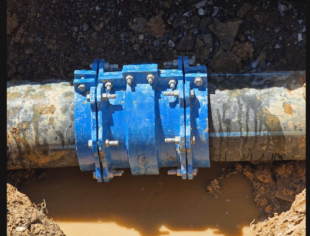
Successfully resolved a pipe burst incident at Phu Tho Water Supply, September 2026.
Why Brass Grips, Not Steel Grips
HDPE pipe is flexible and smooth, with no threads like metal pipe, so the clamp must grip the pipe body tightly to prevent it from slipping off under water pressure. The brass grip is designed to bite into and hold HDPE pipe firmly, preventing slippage throughout the service life of the repair.
Brass also does not corrode the way ordinary steel does when buried in damp soil or exposed to water long-term – and since the grip itself is not a replaceable part, its durability determines the service life of the entire clamp assembly.
Many repair clamps on the market have a body made of rigid HDPE plastic (two plastic halves clamped together). The ATK repair clamp uses a ductile iron FCD450 body combined with brass grips – handling load far better than a plastic body, suitable for locations under high water pressure or on critical pipeline routes.
A Real-World Lesson: Plastic Clamp Failed, Had to Be Urgently Replaced With a Brass-Grip Iron Clamp
On-site repair at Ngo 1 Kim Ngoc, Hanoi, October 24, 2026: a previously installed plastic-body repair clamp failed and had to be dug up and urgently replaced with an ATK brass-grip iron clamp.
This isn’t just material theory. West Hanoi Clean Water once installed a plastic-body repair clamp at one location; that plastic clamp later failed, requiring the site to be dug up a second time for emergency repair and replacement with an ATK brass-grip iron clamp. One location had to be excavated twice, costing extra time and labor/equipment expense compared to using the correct brass-grip iron clamp from the start.
Construction
- Clamp body: ductile iron FCD450
- Grip: yellow brass
- Grip cover: ductile iron FCD450
- Bolts: hot-dip galvanized steel, grade 8.8 (can be swapped for ductile iron or stainless steel on request)
- Gasket: EPDM rubber
- Outer coating: glossy epoxy paint, durable, suited to buried conditions
Manufactured to ISO 2531:2009.
Application: Quick Repair for Burst or Leaking HDPE Pipe Welds
Repairs a burst section or failed weld joint on HDPE pipe without digging up and replacing the whole pipe segment. Fast installation: clamp around the damaged area, tighten the bolts, done – no specialized equipment or on-site welder needed.
Real installation footage: West Hanoi Clean Water using an ATK DN350 brass-grip repair clamp to resolve a pipe burst incident in the field, October 2026.
Saves Time and Cost for Water Utilities
This is the main reason the brass-grip repair clamp is a better choice than the traditional pipe repair method:
- No need to dig up and replace the whole pipe segment. The old method (cutting out the damaged section, welding a new joint, or replacing the pipe) requires a wider excavation and an on-site welder or specialized pipe-jointing equipment. A repair clamp only needs enough digging to expose the burst point, then clamp and tighten the bolts.
- Less labor, less equipment. No welding machine needed, no new replacement pipe segment (saving material cost), no need for a highly skilled welder on standby.
- Shorter water outage time. Shorter installation time means the affected residential area or customers lose water for fewer hours – easing pressure on the utility when handling an emergency, especially at night or during peak hours.
- The existing pipe section can be reused immediately, without discarding an otherwise sound pipe segment over one small burst point.
The two real-world videos above (West Hanoi Clean Water, DN350) and the photos from the Phu Tho Water Supply repair are examples of how quickly and smoothly this process runs in the actual field, not a demonstration under ideal conditions. Conversely, the plastic clamp failure case at Ngo 1 Kim Ngoc (Hanoi) mentioned above is an example of how choosing the wrong clamp material ends up far more costly: the same location had to be dug up twice.
Specifications by DN (PN16)
| DN | HDPE Pipe Range | Inner Diameter – d (mm) | Thickness – t (mm) | Length – L (mm) |
|---|---|---|---|---|
| 100 | 110 | 120 | 7.2 | 170 |
| 150 | 160 | 173 | 7.8 | 200 |
| 200 | 200 | 208 | 8.4 | 250 |
| 225 | 225 | 230 | 8.4 | 250 |
| 250 | 250 | 260 | 9 | 280 |
| 280 | 280 | 286 | 9 | 280 |
| 300 | 315 | 322 | 9.6 | 300 |
| 350 | 355 | 365 | 10.2 | 320 |
| 400 | 400 | 410 | 10.8 | 350 |
| 450 | – | – | – | 450 |
| 500 | – | – | – | 450 |
| 600 | – | – | – | 450 |
From DN450 and above: the current public technical catalogue only lists full specifications up to DN400; lengths for DN450-600 are already in actual production, but inner diameter/thickness figures are not yet published.
HCL manufactures the ATK brass-grip repair clamp at its Quat Dong factory (Hanoi). For help choosing the right DN or a quote for your specific project, please contact HCL for support.